
Most strategies leave quite a lot open. They may be clear about where the business wants to go and even about the choices required to get there. But they cannot prescribe what someone should do in every meeting, customer conversation, budget discussion or disagreement between teams.
Nor should they. Someone still has to interpret what the strategy means in that particular situation. And when hundreds or thousands of people do this every day, the way they interpret it matters at least as much as how clearly the strategy was originally formulated.
Culture tends to enter the conversation when there is a problem with engagement, values or behavior. When strategy isn’t moving, we use different words. We talk about alignment, accountability, communication, execution or change fatigue. But look underneath some of those problems and you find something more concrete.
Take a company that wants to move faster. The strategy is clear and people understand why speed matters. But important decisions still need approval from several levels, managers are held accountable for everything their teams do and mistakes receive considerably more attention than sensible decisions that worked out well.
People wait.
You could call that a mindset problem. You could tell managers to empower their teams and employees to take more ownership. But waiting may actually be a pretty sensible response to the organization they work in.
That, to me, is culture. Not just what people believe or the values they share, but the patterns that develop in response to how the organization actually works.
Culture becomes much more tangible when you look at it this way
Instead of asking what kind of culture an organization has, I find it more useful to look at what keeps producing the behavior we see.
There are seven things I tend to look at.
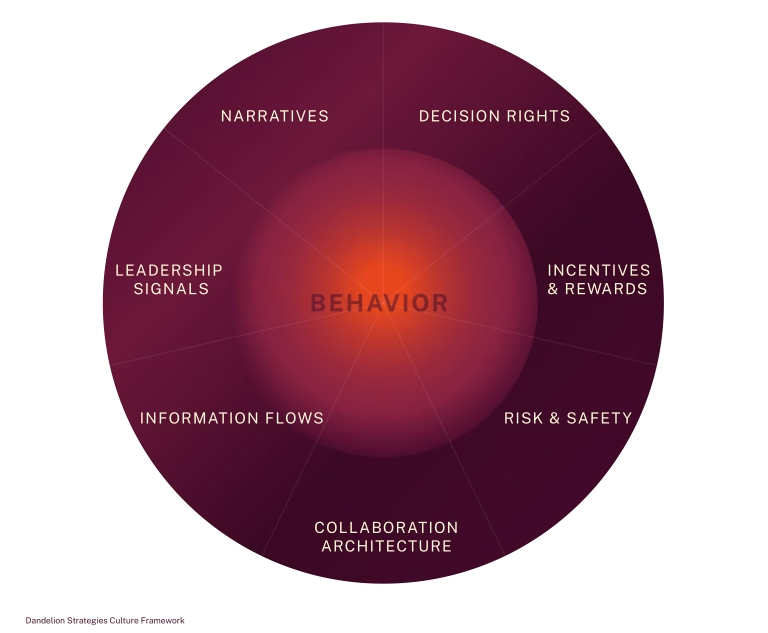
- Decision rights are about where authority actually sits. Not where the organizational chart suggests it sits, but who can make a meaningful decision without asking someone else. If a strategy requires more local ownership while important decisions continue to travel upwards, there is a contradiction worth examining.
- Incentives and rewards tell us what the organization really values. Pay is part of this, but so are targets, budgets, promotions, recognition and status. A company can ask functions to collaborate while continuing to measure their success independently. Neither message is necessarily unclear. They just point in different directions.
- Risk and safety affect what happens when the right decision is uncertain. Most strategies involve some form of change, which means people will occasionally get things wrong. How the organization responds teaches people how much experimentation, challenge or initiative is actually sensible.
- Collaboration architecture matters because most strategies eventually have to cross organizational boundaries. Teams may genuinely want the same outcome and still make life difficult for each other because responsibilities overlap, processes don’t connect or solving one team’s problem creates another team’s problem.
- Information flows determine what people can see when they make a decision. Different decisions do not necessarily mean people disagree about the strategy. They may be working with different information, different metrics or a different understanding of what is happening elsewhere in the business.
- Leadership signals are particularly interesting because leaders send them all the time, whether they intend to or not. What gets attention in a meeting, which questions are asked, who gets promoted and what happens when targets are under pressure all help people understand what matters more than something else.
- And then there are narratives. The stories organizations tell themselves about how things work here. Some are explicit, many aren’t. They might be about customers, headquarters, a previous reorganization, a successful founder or why a certain initiative failed five years ago. They become shorthand for what people have learned about the organization.
None of these is culture on its own. And I don’t think there is much value in trying to score all seven and declaring that an organization has a 7.4 out of 10 culture. Their value is in looking at how they interact.
Imagine again the company that wants more ownership. You discover that decisions are formally delegated, so decision rights don’t initially appear to be the problem. But managers still intervene because they remain accountable for the outcome. Employees know this, so they involve their managers early. When something goes wrong, senior leaders start asking why they weren’t involved sooner.
Before long, everyone is escalating again.
No single person has to oppose the strategy for this to happen. There doesn’t even have to be much disagreement about it. The different parts of the organization simply combine to make the old behavior more sensible than the new one.
This is why I think describing culture as a system is useful. It moves the conversation away from whether people have the right mindset and towards the conditions under which they are being asked to behave differently.
The point isn’t to design the perfect culture
We don’t believe there is one.
Organizations contain contradictions because businesses contain contradictions. We want people to move quickly and manage risk. We want global consistency and local autonomy. We want collaboration and clear accountability. We want people to experiment and hit their targets. You cannot solve all of those tensions, nor should you try.
The strategy tells you which ones currently matter.
If growth depends on local teams making faster decisions, it becomes useful to understand why decisions still move upwards. If the strategy depends on several business units selling together, it becomes useful to understand why they continue to optimize separately. If innovation matters, you need to know whether the organization makes taking a sensible risk worthwhile.
That is a different starting point from a culture transformation.
You start with what the business is trying to achieve, look at the behavior that would make that possible and then examine what in the current organization makes that behavior logical or illogical. Sometimes you will find something structural. Sometimes the issue really is leadership behavior. Sometimes people don’t have the information they need. And sometimes you may discover that culture isn’t the main problem at all.
That last possibility matters. Culture has become broad enough as a concept that almost any organizational problem can be explained through it if you try hard enough. That doesn’t make the explanation useful.
So what does this have to do with performance?
I would be careful with claims that a particular culture automatically leads to better performance. Businesses are too complicated for that and successful companies can have remarkably different cultures. The more interesting connection is much closer to the work itself.
Decisions that repeatedly travel through unnecessary approval layers take longer. Teams working from different interpretations of the same priority create variation. Conflicting incentives make collaboration more expensive. Information that arrives late changes the quality and timing of decisions. Leaders who repeatedly have to intervene to resolve the same tensions are compensating for something the organization isn’t resolving itself.
Those things have a cost.
And that is why I think culture belongs in a strategic conversation. Not because culture is somehow more important than we used to think, but because some of the things we call culture determine how expensive and difficult it is for an organization to do what its strategy asks of it.
The practical question therefore isn’t whether your culture supports your strategy. That is still too broad to be particularly useful.
A better question is: where does the way our organization currently works make the behavior our strategy requires less likely?
That is the question behind our work on making strategy work. We start with the strategy, identify the places where execution keeps producing friction and work backwards to understand what is causing it.
Sometimes that means changing decision rights or incentives. Sometimes leadership behavior or information flows. Usually it is a combination. The point isn’t to redesign the organization around a culture model. It is to change the few things that are getting in the way of what the business is trying to do.
Your organization will have a culture regardless. The useful part is understanding what it is producing.
Want to explore what this means for your organization?