
Every year, organizations announce new strategies. The ambition is clear: to integrate, digitize, centralize, standardize or scale. And yet, twelve to eighteen months later, the organization often feels familiar.
The initiative exists, but the way people work has barely shifted. This is not an isolated experience. Research consistently shows that only a minority of transformation programs deliver sustained value. Digital initiatives struggle to move beyond pilots. AI investments remain trapped in experimentation. Integration efforts generate more alignment meetings than measurable synergy. Strategy quality itself is rarely the constraint. The difficulty lies in translating intent into everyday execution.
From the outside, this looks like an execution gap. From the inside, it feels heavier. Decisions move slowly. Escalation increases. Coordination absorbs time. Energy rises, but momentum does not.
Leaders describe the frustration like:
- We’re aligned, but nothing really shifts
- We’ve redesigned the model, but collaboration is still hard.
- We talk about ownership, yet decisions still climb the hierarchy.
This is rarely resistance. Instead, it is operating logic.
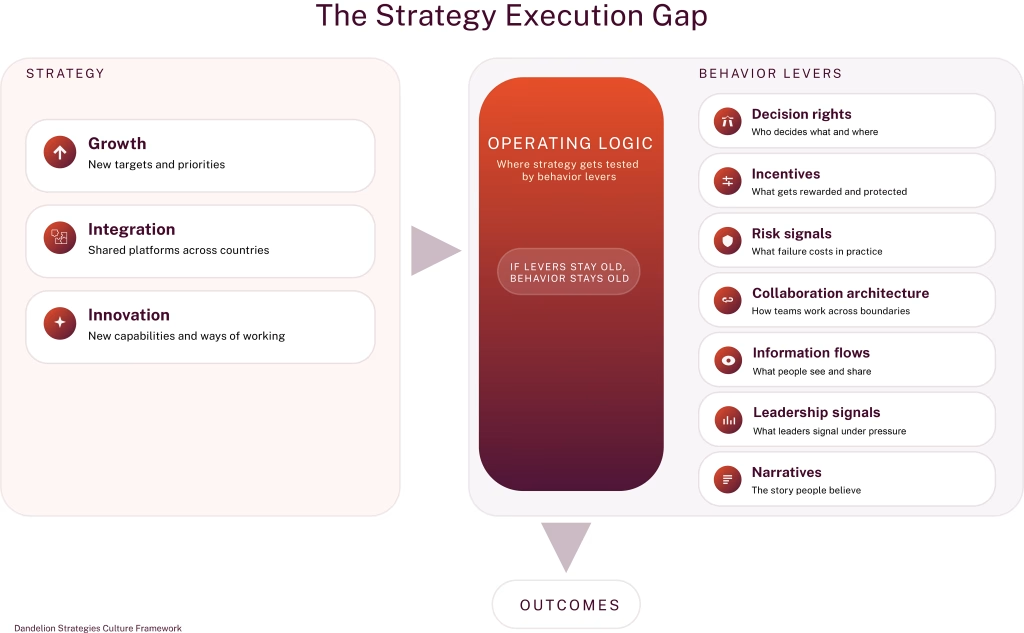
Every organization runs on a set of structural levers that quietly shape behavior. They are not always visible in strategy decks, yet they determine how work actually gets done. Where authority sits. What gets rewarded. How risk is treated. How collaboration across functions or countries unfolds. What information travels and what remains local. What leaders tolerate under pressure. The narrative people use to interpret what is happening.
When those levers remain unchanged, behavior remains consistent with the past. Strategy shifts on paper. The underlying logic does not. This is why effort alone rarely resolves the issue. When execution lags, organizations often respond with more communication, more training, or renewed engagement campaigns. These can clarify direction, but they do not alter the environment in which decisions are made.
Communication cannot compensate for incentives that reward yesterday’s priorities. Training does not remove ambiguity in decision rights. Motivation does not eliminate structural friction between teams. If local optimization is still the safest path to performance, people will continue to optimize locally. If risk remains unevenly distributed, caution will dominate. If leadership signals contradict stated intent, the contradiction will shape behavior more than any message.
In each case, the organization is behaving rationally within its own conditions.
The economic consequences are measurable. Synergies arrive later than forecast. Growth initiatives demand disproportionate executive attention. Integration costs rise. Digital programs underdeliver. The organization becomes more complex as it tries to become more agile. Over time, performance depends increasingly on individual effort rather than organizational design.
This is where culture becomes relevant, though not in the way it is usually framed.
In an earlier article, I described culture not as values on a wall but as a system. A set of interacting mechanisms that shape how strategy is interpreted and translated into action. Culture, in this sense, is the infrastructure of execution.
Most transformations redesign processes and technology. Fewer redesign this infrastructure.
Organizations that execute consistently well tend to take a different approach. When they change direction, they examine whether authority structures support the new ambition. They align incentives with revised priorities. They simplify collaboration across boundaries so that the desired behavior becomes easier rather than harder. They clarify risk boundaries. They ensure information flows reinforce what matters. They calibrate leadership behavior. And they consciously shape the narrative that gives meaning to change.
They do not attempt to persuade people into new behavior while preserving the old conditions. They adjust the conditions.
When those underlying mechanisms support the chosen direction, something shifts. Decisions move with less friction. Collaboration requires less coordination effort. Fewer conversations revolve around alignment. Strategy shows up in daily behavior without continuous reinforcement. Performance becomes more predictable, not because the organization is more inspired, but because it is more coherent.
The persistent failure of many transformations is therefore not primarily a human problem. It is a design problem.
Leaders adjust direction. They leave the operating logic intact. As long as yesterday’s structural behavior levers outweigh today’s ambition, the outcome is predictable. Agreement increases. Execution remains familiar.
A more useful starting point is not to ask how to convince people to embrace change. It is to ask where the organization’s current design still contradicts its chosen direction. That shift moves the conversation away from persuasion and towards architecture. Away from slogans and towards mechanics.
Understanding where the execution gap comes from is only useful if you can trace it back to the way the organization actually works. Which decisions keep getting stuck? Which incentives pull people in another direction? Where does information stop travelling? What do leaders unintentionally reinforce?
That is the starting point for making strategy work: identifying the parts of the organization that keep producing the friction and changing those that matter for the strategy.